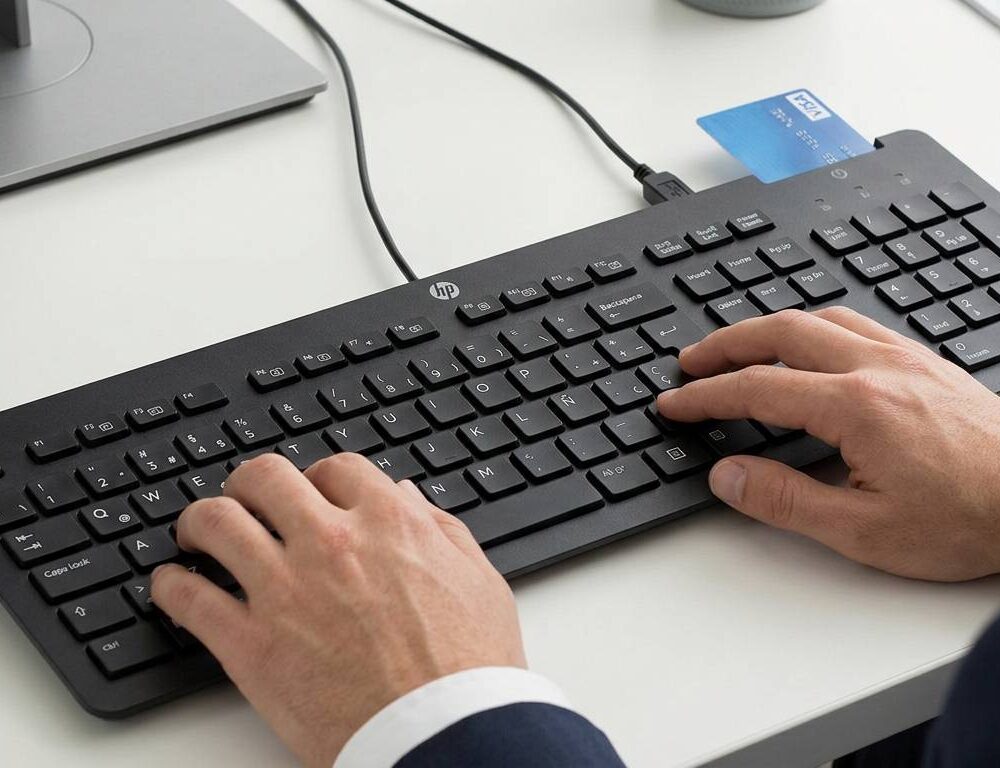
Companies operating across Spain and Latin America face a challenge that many IT departments overlook until it causes real disruption: authentication hardware that does not match the way local staff actually type. A smartcard reader bolted onto a generic keyboard might tick a security box, but if the layout ignores the accents, the inverted question marks, and the Ñ that Spanish typing depends on, staff end up fighting their own equipment just to log in. Getting this right is not a cosmetic preference. It affects speed, accuracy, and the everyday confidence of anyone who logs into a secure system multiple times a day.
This is exactly the gap that a well-specified device is built to close. The HP Spanish Smart Card keyboard brings together a genuine Spanish QWERTY layout with a built-in CCID-compliant smart card reader, so employees can authenticate and type in their native language without reaching for a separate USB peripheral or adapting to an unfamiliar key arrangement. For IT teams supporting offices in Madrid, Mexico City, or Buenos Aires alike, that combination removes a persistent source of friction from the working day.
Why Native Layout and Card Reading Belong Together
Spanish keyboards differ from standard English layouts in ways that matter far more than most procurement teams assume. The Ñ key, accented vowels (á, é, í, ó, ú), and the inverted exclamation and question marks (¡, ¿) are essential for accurate written Spanish, not optional extras. A keyboard without them forces staff into workarounds, slows data entry, and increases the likelihood of typing errors in official documents, emails, and secure forms.
The Role of CCID in Everyday Security
CCID, short for Chip Card Interface Device, is the USB standard that lets an operating system recognise a smartcard reader instantly, without hunting for proprietary drivers. For organisations managing hundreds of workstations, this standardisation delivers clear operational advantages:
- Immediate recognition across Windows, macOS and Linux without extra software
- Fewer support tickets caused by driver conflicts or outdated firmware
- Consistent, predictable performance across large hardware deployments
- Easier long-term maintenance as operating systems are updated
Accessibility Should Never Be an Afterthought
Security hardware is often engineered purely for compliance, leaving accessibility as a secondary concern. That is a mistake, given how many staff members rely on clear, legible input devices to work comfortably. High Visibility Keyboards and High Contrast Keyboard designs, featuring bold and clearly defined characters, make a tangible difference for visually impaired and low vision seniors who still need to authenticate each day securely. Good hardware design should never make people choose between accessibility and functionality.
Procurement teams building genuinely inclusive workplaces increasingly look for suppliers who stock both language-specific and accessibility-focused ranges together. Browsing CCID Spanish Smartcard Security keyboards alongside oversized-letter and high-contrast alternatives makes it far simpler to equip a diverse workforce without juggling multiple suppliers or inconsistent stock availability.
What IT Buyers Should Check Before Ordering
Before committing to a bulk order of secure Spanish-layout keyboards, IT procurement teams should confirm the following:
- Genuine Spanish QWERTY key mapping, not a relabelled English keyboard
- Verified CCID certification for driverless, cross-platform compatibility
- Durable construction suited to continuous daily use
- Spill-resistant or washable models for shared or clinical settings
- Availability of high-contrast or oversized-letter variants for accessibility needs
Where This Hardware Earns Its Place
Spanish-layout smartcard keyboards are not a specialist curiosity; they are practical infrastructure across several industries.
Public sector offices: Government departments across Spain and Latin America frequently require smartcard authentication for accessing citizen records, making CCID compliance a genuine procurement necessity rather than a nice-to-have.
Healthcare providers: Hospitals and clinics rely on shared workstations where staff authenticate repeatedly throughout a shift, so a keyboard that types correctly the first time reduces delays at critical moments.
Financial services: Banks across Spanish-speaking markets often require a physical smartcard tap before transactions proceed, meaning reliability under constant daily use is essential rather than optional.
International businesses: Companies with Spanish-speaking offices benefit from hardware that mirrors local typing conventions precisely, avoiding the productivity dip caused by an unfamiliar layout.
Rolling It Out Sensibly
A phased rollout works best. Trial a small batch of devices with one department, gather honest feedback on typing comfort and card-reading reliability, then scale up once any configuration issues are ironed out. Keeping a small reserve of spare units on hand also prevents downtime in environments that operate around the clock, such as hospitals or customer service centres.
Right Keys, Right Access
Choosing a genuine Spanish-layout smartcard keyboard with proper CCID support removes unnecessary friction from daily work. It protects sensitive systems, respects native typing habits, and, when paired with high-contrast or oversized-letter options, supports colleagues with visual impairments too. For any organisation equipping Spanish-speaking teams, this decision delivers real, lasting value in security, comfort, and everyday reliability.